
Assembling a pool table requires careful attention to detail, often aided by a pool table assembly instructions PDF.
Proper setup ensures optimal gameplay and longevity, avoiding frustrating issues later on.
Understanding the Importance of Proper Assembly
Proper pool table assembly, guided by a detailed pool table assembly instructions PDF, is paramount for a level playing field and consistent ball roll. Incorrect assembly can lead to frustrating gameplay issues, including unpredictable ball behavior and uneven surfaces.
A correctly assembled table maximizes enjoyment and extends the table’s lifespan. Following instructions meticulously ensures structural integrity, preventing wobbling or potential damage. Ignoring proper procedures can void warranties and necessitate costly repairs. Prioritizing accurate assembly guarantees a professional and satisfying billiards experience for years to come.
Tools Required for Assembly
A successful pool table assembly, referencing a comprehensive pool table assembly instructions PDF, demands specific tools. Essential items include a socket wrench set, various screwdrivers (Phillips and flathead), a level (spirit level is best), and a rubber mallet.
A staple gun is crucial for cloth installation, while a tape measure ensures accurate measurements; Power drills with adjustable clutch settings can expedite screw driving, but caution is advised. Having shims handy aids in leveling, and safety glasses protect your eyes.
Safety Precautions During Assembly
Prioritize safety throughout the pool table assembly process, consulting your pool table assembly instructions PDF for specific warnings. Wear safety glasses to protect against flying debris, especially when using power tools.
Lift heavy components – like the slate – with assistance to prevent back strain. Ensure a clear, spacious work area, free from obstructions. Use gloves to protect hands from sharp edges and splinters.
Be mindful of pinch points during frame assembly and secure all bolts firmly, but avoid over-tightening.

Unboxing and Inventory
Carefully unpack all components, referencing the pool table assembly instructions PDF. Verify every part is present and undamaged before beginning assembly.
Checking the Package Contents
Begin by thoroughly inspecting all boxes for external damage before opening. Once opened, cross-reference the physical contents with the parts list detailed in your pool table assembly instructions PDF.
This document is crucial; it outlines every component, from the slate pieces and frame rails to the smallest screws and pocket liners.
Count each item and note any discrepancies immediately. Pay close attention to the slate, ensuring it’s intact and free of cracks. Document everything with photos for potential claims.
Identifying All Parts (Referencing the PDF Manual)
Utilize the exploded diagrams within your pool table assembly instructions PDF to precisely identify each component. The manual will detail various rail types, slate support pieces, leg assemblies, and hardware.
Familiarize yourself with screw sizes and types – often categorized in separate bags.
Lay out all parts in an organized manner, grouping similar items together. This prevents confusion during assembly. The PDF’s part numbers are essential for accurate identification and troubleshooting.
Dealing with Missing or Damaged Parts
If, upon inventory using your pool table assembly instructions PDF, parts are missing or damaged, immediately contact the retailer or manufacturer. Document everything with photos – clearly showing the damage or the empty space where a part should be.
Reference the part numbers from the PDF when communicating.
Do not attempt to substitute parts or proceed with assembly using damaged components; this could compromise structural integrity. Request replacements promptly to avoid delays.

Frame Assembly
Following your pool table assembly instructions PDF, carefully connect the side and end rails, ensuring a snug fit.
This forms the foundational structure for the table.
Attaching the Side Rails to the End Rails
Referencing your pool table assembly instructions PDF is crucial during this stage. Typically, this involves aligning the pre-drilled holes in the side rails with those in the end rails.
Use the provided bolts and fasteners, tightening them gradually in a criss-cross pattern.
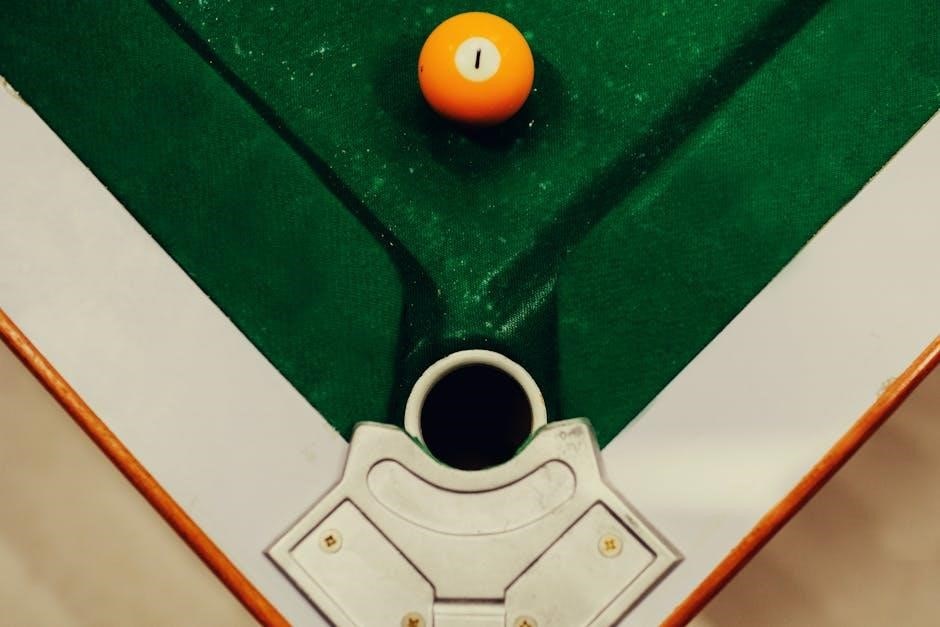
Avoid over-tightening initially, as this can cause misalignment.
Ensure the corners are flush and square before fully securing the connections.
Proper alignment here is fundamental for a level and stable playing surface, impacting gameplay significantly.
Assembling the Corner Pieces
Consulting your pool table assembly instructions PDF will guide you through attaching the corner pieces to the assembled frame. These pieces often utilize metal brackets and bolts for secure fastening.
Carefully align the corner pieces, ensuring they fit snugly against both the side and end rails.
Tighten the bolts incrementally, maintaining a square and even fit.
Pay close attention to the orientation of the corner pieces, as incorrect placement can affect pocket alignment later.
A solid corner assembly is vital for overall frame stability.
Ensuring Frame Squareness and Stability
Referencing your pool table assembly instructions PDF, verifying the frame’s squareness is crucial before proceeding. Use a carpenter’s square at each corner to confirm 90-degree angles.
Diagonal measurements should be identical; discrepancies indicate a non-square frame.
Adjust the frame gently until square, then fully tighten all bolts.
A stable frame prevents racking issues and ensures accurate ball travel.
Check for wobble; shims under the legs may be needed on uneven floors for optimal stability.

Slate Installation
Consult your pool table assembly instructions PDF for proper slate handling and placement. This critical step demands precision and care for a level playing surface.
Positioning the Slate on the Frame
Carefully review your pool table assembly instructions PDF before attempting to position the slate. Typically, this involves lifting the slate sections – often with assistance due to their weight – and gently lowering them onto the assembled frame.
Ensure the frame is completely level before slate placement. Precise alignment is crucial; misaligned slate can lead to uneven gameplay. Some PDFs detail specific slate orientation, noting any marked sides or designated positions. Use protective padding beneath the slate during placement to prevent scratches or damage to both the slate and the frame.
Double-check alignment with the frame’s edges before proceeding to the leveling stage.
Leveling the Slate (Critical Step)
Your pool table assembly instructions PDF will emphasize leveling as the most critical step. Utilize a precision level – a spirit level or laser level is recommended – to check the slate’s flatness in multiple directions.
Adjust the frame’s leveling feet until the slate is perfectly level. This often requires iterative adjustments, checking and re-checking across the entire surface. Unevenness impacts ball roll and gameplay accuracy.
The PDF may detail specific leveling point locations. Patience is key; achieving a truly level slate is paramount for a professional playing experience.
Securing the Slate to the Frame
Refer to your pool table assembly instructions PDF for specific guidance on securing the slate. Typically, this involves using specialized slate screws or bolts, carefully inserted into pre-drilled holes in both the slate and the frame.
Ensure screws are tightened evenly and gradually, avoiding over-tightening which could crack the slate. The PDF will likely specify a tightening pattern to distribute pressure uniformly.
Proper securing prevents shifting during play, maintaining a consistent and accurate playing surface. Double-check all fasteners for tightness after initial assembly.

Cloth Installation
Pool table assembly instructions PDF guides precise cloth stretching and attachment. Proper tension is crucial for consistent ball roll and professional play.
Preparing the Slate Surface
According to pool table assembly instructions PDF documents, meticulous slate preparation is paramount. Begin by thoroughly cleaning the slate surface, removing any dust, debris, or residual adhesive from previous installations. Inspect for imperfections – minor scratches can often be addressed with specialized slate filler.
Ensure the slate is perfectly level before proceeding; any unevenness will translate to inconsistent ball behavior. A smooth, clean, and level slate provides the ideal foundation for optimal cloth adhesion and a superior playing experience. Proper preparation prevents future cloth wrinkles and ensures longevity.
Stretching and Securing the Cloth
Pool table assembly instructions PDF guides emphasize the critical importance of proper cloth stretching. Begin by carefully positioning the cloth, ensuring even overhang on all sides of the slate. Using specialized stretching tools, gradually pull the cloth taut, working from the center outwards to eliminate wrinkles.
Secure the cloth temporarily with staples or adhesive, then systematically work around the perimeter, ensuring consistent tension. Final securing involves precise stapling or gluing, creating a smooth, drum-tight surface essential for accurate ball roll and optimal play.
Trimming Excess Cloth
Pool table assembly instructions PDF documents detail a precise trimming process. After stretching and securing, carefully trim the excess cloth around the slate perimeter, leaving a small margin for a clean finish. Utilize a sharp utility knife or specialized trimming tools, following the slate’s edges closely.
Avoid cutting too close initially; a second pass can refine the edge. Mitered corners require extra precision for a professional look. Properly trimmed cloth ensures a neat appearance and prevents interference with rail attachment.

Pocket Installation
Pool table assembly instructions PDF guides precise pocket placement. Secure pocket linings and then attach pockets to the slate, ensuring correct alignment for fair play.
Attaching the Pocket Linings
Referring to your pool table assembly instructions PDF is crucial for correctly attaching pocket linings. Begin by carefully positioning each lining within the designated pocket opening on the slate.
Ensure the lining’s orientation matches the diagram in the manual; incorrect placement impacts ball return. Apply a thin, even bead of wood glue around the lining’s perimeter before gently pressing it into place.
Use clamps to secure the lining firmly against the slate while the glue dries – typically several hours. Wipe away any excess glue immediately with a damp cloth to prevent residue buildup. Precise alignment is key for professional-grade pocket performance.
Securing the Pockets to the Slate
Consult your pool table assembly instructions PDF for the correct screws and placement when securing pockets to the slate. Typically, pockets are attached using specialized bolts that thread into pre-drilled holes within the slate.
Ensure the pocket is flush with the slate surface before tightening the screws; avoid over-tightening, which can crack the slate.
Use a screwdriver with appropriate bit size to prevent stripping the screw heads. Double-check each pocket’s stability after tightening, ensuring it doesn’t wobble or shift. Proper securing guarantees consistent ball capture.
Ensuring Proper Pocket Alignment
Refer to your pool table assembly instructions PDF for precise pocket placement measurements. Accurate alignment is crucial for fair gameplay and professional ball return. Use a straight edge or measuring tape to verify that each pocket is equidistant from the rails and corners.
Slight misalignments can affect ball trajectory.
Check alignment from multiple angles to confirm consistency. If adjustments are needed, loosen the securing bolts slightly, reposition the pocket, and re-tighten. Prioritize precision during this step for a level playing field.

Rail Cushion Installation
Consult your pool table assembly instructions PDF for guidance on attaching cushions to rails.
Proper tension and alignment are vital for accurate ball rebound and gameplay.
Attaching the Cushions to the Rails
Referencing your pool table assembly instructions PDF is crucial when attaching cushions. Typically, this involves aligning the cushion profile with the rail’s pre-drilled holes.
Use the provided screws, ensuring they are tightened evenly to distribute tension uniformly. Avoid over-tightening, which can damage the wood or cushion material.
Some models utilize a specialized adhesive in conjunction with screws for enhanced bonding. Carefully follow the PDF’s diagrams to ensure correct cushion placement and orientation for optimal ball response.
Incorrect attachment impacts playability.
Ensuring Proper Cushion Alignment and Tension
Your pool table assembly instructions PDF will detail how to achieve correct cushion alignment and tension. Consistent tension across all cushions is vital for predictable ball behavior.
Use a straight edge to verify cushions are flush with the rail’s surface. Tighten screws incrementally, checking for even rebound after each adjustment.
Uneven tension causes erratic ball movement. The PDF may suggest a specific deflection test – pressing the cushion and measuring its rebound – to confirm proper setup. Prioritize uniformity for a professional playing experience.
Securing the Rails to the Frame
Refer to your pool table assembly instructions PDF for precise guidance on securing the rails to the frame. This step is crucial for table stability and accurate play.
Typically, this involves using bolts and washers, tightened systematically. Ensure the rails sit flush against the frame before fully tightening.
Avoid over-tightening, which can damage the wood. The PDF may specify a torque setting. Double-check all fasteners are secure, preventing unwanted movement during gameplay and ensuring a level playing surface.

Leg Attachment
Consult your pool table assembly instructions PDF for leg attachment specifics. Securely fasten legs to the frame, ensuring stability and proper weight distribution.
Attaching the Legs to the Frame
Refer to your pool table assembly instructions PDF for precise guidance on leg attachment. Typically, this involves aligning the legs with pre-drilled holes in the frame’s corners.
Use the provided bolts and washers, tightening them gradually in a criss-cross pattern to ensure even pressure. Avoid over-tightening initially, as this can stress the wood.
Double-check that each leg is flush with the frame before fully securing. Some tables utilize a bracket system; the PDF will illustrate this clearly. Proper leg attachment is crucial for overall table stability and preventing wobbling during gameplay.
Leveling the Table with Adjustable Feet
Consult your pool table assembly instructions PDF for detailed leveling procedures. Most tables feature adjustable feet, allowing for fine-tuning on uneven floors.
Begin by placing a spirit level on the slate, checking both lengthwise and widthwise. Rotate each foot incrementally, observing the level’s bubble until it centers.
Repeat this process multiple times, as adjusting one foot affects others. Patience is key! A perfectly level table ensures accurate ball roll and a professional playing experience. Prioritize this step for optimal results.
Ensuring Leg Stability
Refer to your pool table assembly instructions PDF for specific guidance on leg attachment and stabilization. Securely fastened legs are crucial for a wobble-free playing surface.
Double-check all bolts and screws, tightening them firmly but avoiding over-tightening, which could damage the wood. Inspect the leg brackets for proper alignment and ensure they are flush against the frame.
If the table feels unsteady, re-examine each leg connection. A stable base is paramount for enjoyable and accurate gameplay, preventing frustrating disruptions during matches.

Final Checks and Adjustments
Consult your pool table assembly instructions PDF for a final review. Re-leveling and tightening all components guarantees a smooth, professional playing experience.
Re-Checking Levelness
Crucially, revisit the leveling process detailed in your pool table assembly instructions PDF. Use a precision spirit level, checking both lengthwise and widthwise across the slate’s surface. Even slight imperfections dramatically impact ball roll.
Adjust the table’s feet – typically threaded for fine-tuning – until the bubble resides perfectly centered within the level’s indicators. Repeat this process multiple times, as adjusting one leg can subtly affect others. Prioritize achieving absolute levelness; it’s fundamental for fair and enjoyable gameplay.
Tightening All Bolts and Screws
Referencing your pool table assembly instructions PDF, systematically tighten every bolt and screw within the frame, leg attachments, and slate securing mechanisms. Use the correct tool – often an Allen wrench or socket – to avoid stripping the heads.
Apply firm, even pressure; avoid over-tightening, which could damage the wood or slate. A thorough tightening ensures structural integrity and prevents unwanted movement during play. Double-check each fastener, confirming a secure fit, guaranteeing a stable and lasting pool table.
Cleaning the Playing Surface
Consult your pool table assembly instructions PDF for recommended cleaning procedures. Initially, use a soft-bristled brush to remove any dust or debris from the cloth surface. Avoid abrasive cleaners, as they can damage the felt.
For minor marks, a specialized pool table cloth cleaner is ideal; apply sparingly and follow the product’s directions. Regular cleaning maintains optimal ball roll and prevents the buildup of oils and grime, preserving the playing quality for years to come.